On this page
What wood stove repair covers
Wood stove repair fixes the parts that control how the fire burns and keep heat, smoke and sparks where they belong. A wood stove is a sealed firebox. It burns cleanly only when the door seals, the air controls respond and the flue connection draws smoke out. When one of those parts wears or breaks, the stove burns hotter, burns dirtier or leaks smoke.
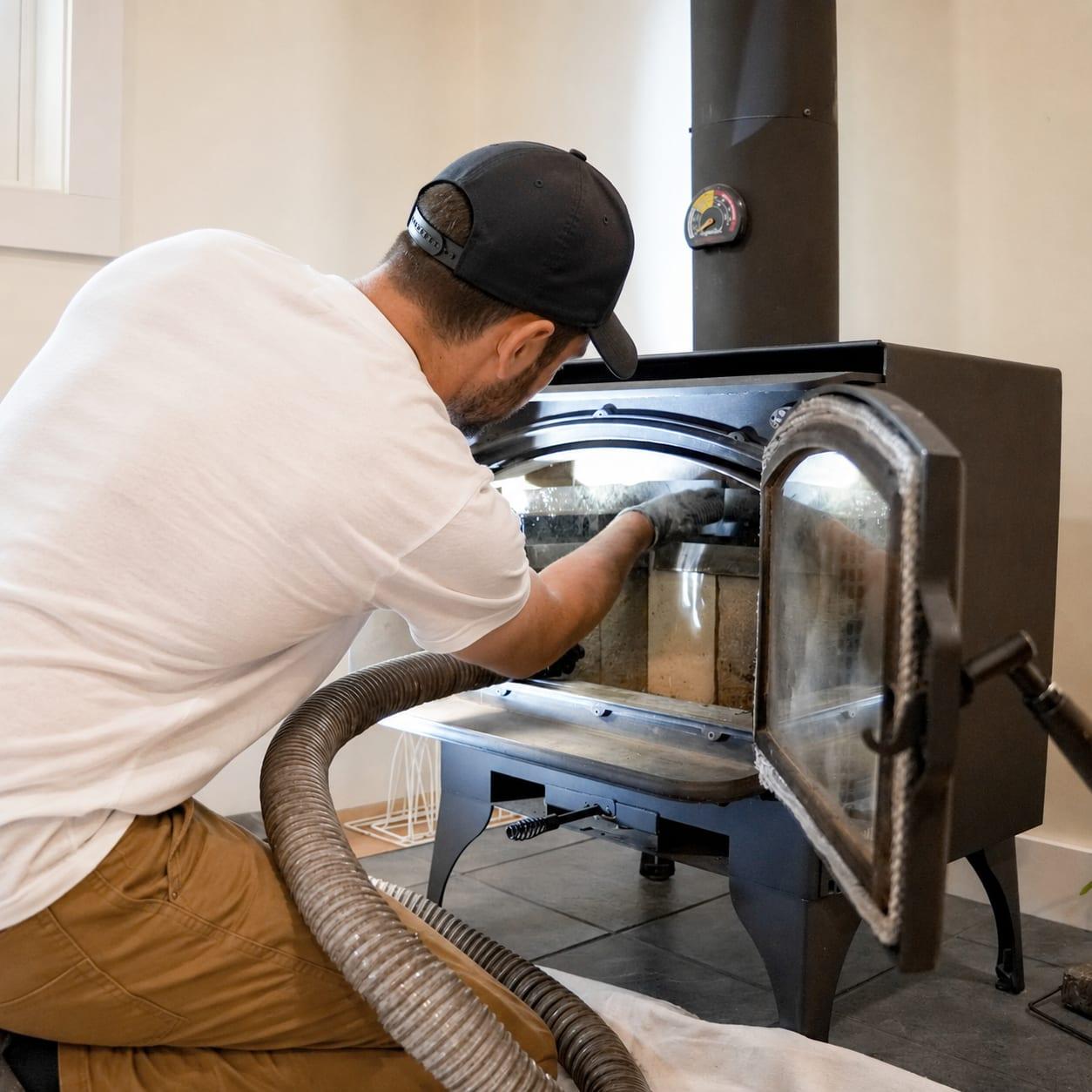
Most repairs replace a worn part with a matching one. That might be a door gasket, a cracked pane of glass, broken firebrick or a warped baffle. Some repairs restore a function instead, such as a sticking air control or a loose stovepipe joint. The goal is a stove that holds a steady fire and stays sealed.
Signs your wood stove needs repair
Most stove problems show up during normal use. Any of these is worth a closer look:
- Smoke comes into the room when the door is closed, or when you open it to load wood
- The fire burns too fast and you can't turn it down, which often points to a leaking door or glass gasket
- The glass turns black quickly even with dry wood
- Cracked, crumbling or missing firebrick inside the firebox
- A sagging or warped baffle plate, or bent secondary air tubes above the fire
- An air control lever or damper that sticks, won't move or does nothing
- Cracked glass, or a door that won't latch tightly
- A loose, rusted or separated stovepipe connection
- Visible cracks or warping in the stove body
Some of these problems look like repair issues but come from buildup in the stove or flue. If the main problem is a heavy layer of soot or creosote, our wood stove cleaning service is usually the right first step. If the stove body is cracked through or the stove no longer suits the room, wood stove installation may be the better path.
Common symptoms and what we check
01Fire won't slow down
- What you may notice
- Wood burns fast with the air control closed; the stove runs very hot.
- How it’s confirmed
- We check the door and glass gaskets for gaps and flattening, and test whether the air control closes fully.
02Smoke spills into the room
- What you may notice
- Smoke smell or haze near the stove; smoke escapes when the door opens.
- How it’s confirmed
- We check the stovepipe joints, the flue connection, the baffle position and the draft.
03Damaged firebox lining
- What you may notice
- Cracked, crumbled or missing firebrick; the steel behind it glows or discolors.
- How it’s confirmed
- We inspect each brick and the stove wall behind any damaged ones.
04Poor burn and dirty glass
- What you may notice
- Fire smolders, glass blackens fast, more smoke at the chimney top.
- How it’s confirmed
- We check the baffle, the secondary air tubes and, on stoves that have one, the catalytic combustor.
What a repair visit involves, step by step
How the visit works
Talk through the symptoms
Tell us what the stove is doing, when it started and how you burn it. That narrows down where to look.
Inspect the stove cold
We check the door, glass, gaskets, firebrick, baffle, air controls and stove body. The stove needs to be out and cool for this.
Check the connection and draft
We look at the stovepipe and how it joins the flue, since many smoke problems start there rather than in the stove.
Explain what we found
You get a plain explanation of what's worn or broken and a free estimate for the repair before any work starts.
Make the repair
We replace or fix the parts you approve, such as gaskets, glass, firebrick, baffle components or connector pipe.
Check the result
We confirm the door seals, the controls work and everything is fitted correctly, and we tell you about anything else to keep an eye on.
Parts that most often need attention
| Part | What it does | Typical problem |
|---|---|---|
| Door and glass gaskets | Seal the firebox so air enters only through the controls | Flatten, harden or pull loose, so the fire burns too fast |
| Glass | Lets you see the fire while keeping it sealed in | Cracks from impact or heat stress; heavy staining |
| Firebrick | Lines the firebox and protects the steel walls | Cracks, crumbles or falls out |
| Baffle and air tubes | Route heat and smoke for a cleaner, more complete burn | Warp, sag, crack or shift out of place |
| Air controls | Set how fast the fire burns | Stick, seize or stop closing fully |
| Catalytic combustor (some stoves) | Burns off smoke for cleaner combustion | Wears out, crumbles or clogs |
| Stovepipe / connector | Carries smoke from the stove to the flue | Joints loosen, rust or separate |
If you're weighing whether to repair an older freestanding unit or switch to a different setup, our guide to fireplace insert vs freestanding wood stove explains how the two compare.
Pellet stove repair
We also offer pellet stove repair. A pellet stove has the same basics as a wood stove — a sealed firebox, gaskets, glass and a vent — but it also has moving and electrical parts that feed and light the fire. Wood pellet stove repair usually involves one of these parts:
- The igniter, when the stove won't light
- The auger and its motor, when pellets stop feeding or feed unevenly
- The combustion blower, when the fire smolders or the stove shuts down
- The convection fan, when the stove burns but doesn't push heat into the room
- Sensors and controls, when the stove shuts off or shows error codes
- Door gaskets and glass, the same as on a wood stove
Pellet stoves are sensitive to ash and fines in the burn pot and vent, so some apparent faults turn out to be buildup. When that's the cause, pellet stove cleaning usually solves it. If you're still choosing between fuel types, our guide to pellet stove vs wood stove covers the practical differences.
Safety while you wait for a repair
Smoke in the room means stop burning
Stop adding fuel, open a window and don't relight the fire until the chimney has been checked. If the smoke is heavy, an alarm sounds or you suspect a chimney fire, get everyone outside and call 911. Open windows to clear the smoke and make sure your carbon monoxide alarm is working.
Burning dry, seasoned wood and keeping the door closed except when loading makes gaskets, glass and firebrick last longer. Burn small amounts of wood at a time, and avoid running the stove at full output for long stretches. Very hot fires warp baffles and crack brick faster.
Booking a wood stove repair
Call or request an estimate, and describe what your stove is doing. Emergency calls are accepted, and 24-hour service runs seven days a week. We work on all major brands of wood and pellet stoves, and we also take on commercial and property-manager work.